
ASEAN is not in the business of collecting acronyms. It is in the business of reducing friction—regulatory, procedural, and strategic. And in 2025, under Malaysia’s Chairmanship, the region has begun to prove it.
The ATIGA upgrade and ASEAN–China FTA 3.0 are not ceremonial headlines. They are foundational building blocks of an integration strategy that finally prioritises function over fanfare.
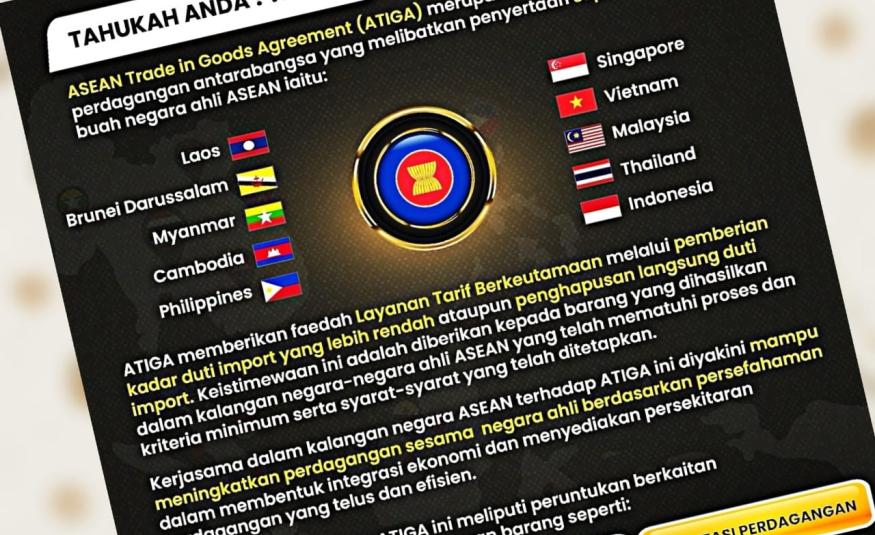
Let’s begin with the upgrade of the ASEAN Trade in Goods Agreement (ATIGA). It marks the first comprehensive revision to ASEAN’s internal trade framework in over a decade.
Ministers have concluded negotiations, and the Second Protocol is slated for signature at the October 2025 Summit. This is not just an administrative update. It directly targets cost drivers and procedural bottlenecks—modernising rules of origin, digitising certificates of origin via e-Form D, and deepening customs connectivity across member states.
In short, it is a practical toolkit for making intra-ASEAN trade faster, clearer, and cheaper.
Malaysia has played a convening role in shepherding this process, reflecting its longstanding preference for trade facilitation over trade bravado.
As one of the region’s most export-oriented economies, Malaysia has skin in the game when it comes to reducing non-tariff barriers and empowering SMEs to plug into cross-border supply chains.
Digital Rules, Real Deliverables: Why ACFTA 3.0 Matters
If ATIGA strengthens the region internally, the ASEAN–China Free Trade Area (ACFTA) 3.0 upgrade extends that logic externally—with strategic consequences.
Concluded in May 2025 and also set for October signature, ACFTA 3.0 embeds entirely new pillars into the economic relationship between ASEAN and its largest trading partner: digital economy, green standards, and supply chain connectivity.
This is no small evolution. These new chapters are not cosmetic. They are structural. They speak to how trade is actually done in the 2020s—where the movement of data, digital authentication, and traceability of carbon emissions increasingly define market access, consumer trust, and regulatory compliance.
The inclusion of these chapters marks a shift from tariff-driven integration to standards-based competitiveness. And crucially, they are interoperable with DEFA—the Digital Economy Framework Agreement that ASEAN is negotiating in parallel.
The direction is clear: ASEAN is wiring itself for a future where integration isn’t declared, but transacted.
From Declaration to Execution: Laying Cables, Not Just Talk
Alongside these trade deals, real infrastructure is being built beneath the radar. ASEAN’s Regional Payment Connectivity initiative—linking instant payment systems and QR code networks across Indonesia, Malaysia, Singapore, Thailand, and beyond—is reshaping how businesses and consumers settle transactions across borders.
For MSMEs, this means being able to sell goods and receive payments from neighbouring countries without currency conversion headaches or settlement delays. For the region, it means integration that you can touch.
This layer of financial plumbing is often ignored in communiqués, but it is what turns free trade agreements into usable, bankable outcomes. Trade rules without payment connectivity are like roads without toll booths—friction remains.
The push to embed these financial layers—alongside the DEFA legal stack—is what will ultimately define whether ASEAN’s integration project delivers results or stalls in abstraction.
ASEAN Is Not Being Pushed—It Is Co-Shaping
Some may still ask whether these updates are ASEAN-led, or simply a response to China’s economic influence or RCEP competition. The answer lies in the choreography. ATIGA was prioritised and concluded first.
ACFTA followed on ASEAN’s terms, with digital and green chapters written into the core. DEFA remains on track. Even the RCEP Support Unit is now operational. These are not signs of a bloc being led. They are signals of a bloc curating—deciding, sequencing, and building deliberately.
ATIGA’s reforms are mostly technical, but meaningful. They patch the operating system—cutting red tape and fixing inefficiencies. ACFTA 3.0 is strategic—it reflects an ASEAN ready to write 21st-century trade rules with its partners. Combined, they show a region debugging its architecture, not rebooting it.
Fix the pipes
If you want results, don’t just shake hands. Fix the pipes, code the protocols, and clear the customs. ASEAN isn’t just negotiating anymore—it’s finally executing. - DagangNews.com
Samirul Ariff Othman is an economist, international relations analyst, adjunct lecturer at Universiti Teknologi PETRONAS (UTP), and a senior consultant with Global Asia Consulting. The views expressed here are entirely his own.
Layari kami terus di DagangNews.com

Orang ramai dipelawa menghantar artikel ke ruangan PARAFRASA di [email protected] mengikut ketetapan berikut:
1. Berbentuk analisis peribadi (Op-Ed) mengenai sesuatu isu atau topik, bukan plagiat
2. Topik yang mendapat perhatian segera dan utama ialah
a. berkaitan perniagaan, perdagangan, keusahawanan, pelaburan
b. Ekonomi MADANI
c. Pembangunan ekonomi negara dan negeri khusus
d. Sektor industri khusus seperti minyak sawit, getah, penerbangan, minyak dan gas
e. ESG
f. Hak pekerja, hak majikan, hak asasi manusia
3. Sains & Teknologi
a. Penemuan penyelidikan Sains & Teknologi serta teori dan konsep
b. Langkah mengkomersialkan produk berasaskan R&D
4. Kaedah penulisan
a) Sebaiknya seorang penulis sahaja pada penama.
b) Berbahasa Malaysia
c) Bahasa Inggeris diterima tetapi akan diterjemah ke Bahasa Malaysia
d) Editor akan memutuskan jika mahu mengekalkan Bahasa Inggeris
e) Tidak melebihi 1,000 patah perkataan dan tidak kurang daripada 600.
f) Jika disertakan gambar, juga amat digalakkan tetapi jangan guna Google (elak langgar hakcipta)
5. Hantar HANYA kepada DagangNews.com
a) Jika didapati artikel sama disiarkan di media lain kerana penulis menghantar merata-rata, nama penulis akan disenaraihitamkan.
b) Sila kemukakan Nama sebenar, Cadangan nama siaran dan emel untuk dihubungi (untuk rekod).