

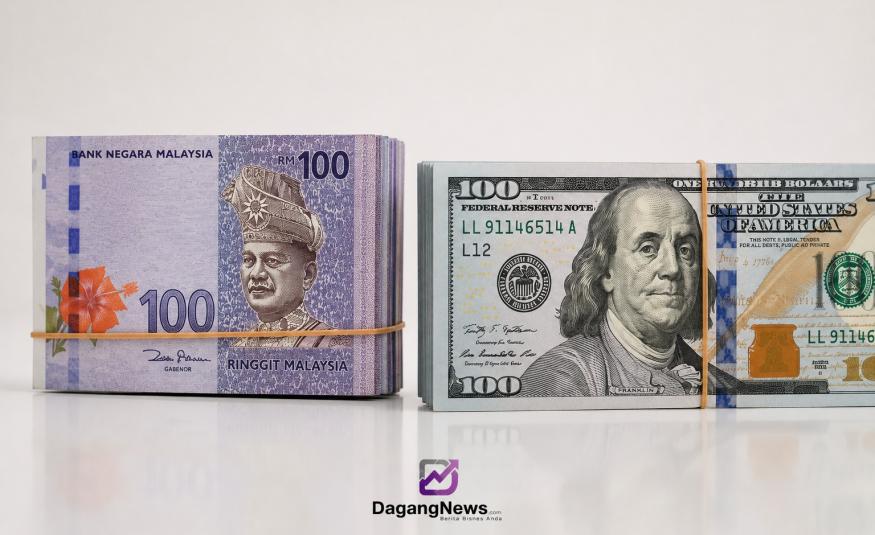
KUALA LUMPUR Aug 19 - The ringgit could weaken beyond RM4.10 against the US dollar if renewed inflationary pressure prompts the Federal Reserve to raise interest rates, although signs of a cooling US economy have reduced the likelihood of such a move in September, Bank Muamalat Malaysia Bhd Chief Economist Dr Mohd Afzanizam Abdul Rashid said.
Bank Negara Malaysia’s interbank exchange-rate table listed the US dollar at RM4.0625 on August 19, about 3.75 sen below the RM4.10 level highlighted by Afzanizam.
“There is a chance that the US dollar-ringgit exchange rate could surpass RM4.10,” he said in written comments to DagangNews.
He identified US interest rates and the resulting strength of the dollar as a more immediate influence on the ringgit than the economic benefits Malaysia might receive from elevated oil prices.
“A US interest-rate increase is the key driver of the ringgit’s direction, and this is contingent upon the prospect of higher inflation in the United States,” he said.

September rate hike not the main expectation
The US Federal Open Market Committee will meet on September 15 and 16, with its interest-rate decision scheduled for September 16.
The Fed will decide whether to retain its target range at 3.50% to 3.75% or, less likely, raise it by 25 basis points to contain inflation that remains above its 2% objective.
Higher US interest rates tend to support the dollar by increasing the relative attractiveness of US assets. This can put pressure on emerging-market currencies and affect foreign portfolio flows into regional financial markets.
“The greater immediate risk would be a rate rise by the US Federal Reserve,” Afzanizam said.
“Higher inflation has always been a contentious point when it comes to the Fed’s decision on interest rates.”
However, a September rate hike is not currently the market’s main expectation.
A Reuters poll published on August 17 found that most economists expected the Fed to keep rates unchanged for the remainder of 2026. Market pricing indicated a roughly one-in-three probability of a September increase.
Expectations of an increase receded following softer inflation, weaker retail sales and an unexpected decline in US employment.
The US Consumer Price Index rose by 0.1% in July and 3.4% from a year earlier. Annual inflation moderated from 3.5% in June, while core inflation eased to 2.5%.
The US economy also lost 23,000 non-farm payroll jobs in July, while the labour-force participation rate declined to 61.4%.
“The latest non-farm payroll figure, which came in lower than expected at minus 23,000 in July, and the labour-force participation rate, which declined to 61.4%, suggest that the US labour market is not entirely robust,” Afzanizam said.
“The rate-hike thesis will always be challenged by those who believe that the prevailing federal funds rate should remain at 3.75%,” he added, referring to the upper limit of the Fed’s current target range.
Oil gains may not shield ringgit
Brent crude traded above US$91 a barrel on August 18 as renewed tensions involving Washington and Tehran intensified concerns over supplies passing through the Strait of Hormuz.
Malaysia can benefit from higher petroleum-related revenue and stronger earnings among selected oil and gas companies when crude prices rise.
However, those benefits may not be sufficient to shield the ringgit if the Fed raises rates and the dollar strengthens.
Expensive oil also raises transportation, logistics, manufacturing and household costs. It can increase government subsidy expenditure even as petroleum-related revenue improves.
Afzanizam said whether Malaysia benefits from higher crude prices would depend substantially on its fuel-subsidy mechanism.
“This really depends on the fuel-subsidy mechanism,” he said.
“Thus far, the present system covers all income cohorts, provided they are Malaysians and possess a valid driving licence.”
Under the BUDI95 programme, eligible Malaysian citizens with a valid driving licence may purchase up to 300 litres of subsidised RON95 petrol monthly.
Domestic fundamentals offer support
Malaysia’s domestic fundamentals could provide some support to the ringgit if external volatility intensifies.
Official figures released on August 14 showed that the economy expanded by 6.0% in the second quarter, exceeding the advance estimate of 5.8% and accelerating from 5.4% in the first quarter.
The economy consequently grew by 5.7% in the first half of 2026, compared with 4.5% during the corresponding period of 2025.
Headline inflation averaged 1.9% during the second quarter, up from 1.6% in the first quarter, while core inflation moderated to 1.9% from 2.1%.
“Thus far, the Malaysian economy is in good condition,” Afzanizam said.
He expects Bank Negara Malaysia to retain its Overnight Policy Rate at 2.75%.
“Bank Negara Malaysia is likely to keep the OPR steady to support economic growth,” he said.
BNM projects headline inflation of between 1.5% and 2.5% in 2026. The central bank said Malaysia’s economic fundamentals, growth momentum and structural reforms should continue to support the ringgit, although external developments remain influential.
Winners and losers from expensive oil
Afzanizam identified upstream oil and gas companies and renewable-energy businesses as potential beneficiaries of elevated crude prices.
“Higher crude-oil prices would mean that efforts to add more renewable-energy capacity become more urgent,” he said.
By contrast, plastics, chemicals, petrochemicals, automotive components and logistics businesses would face higher operating and input costs.
These pressures could eventually affect corporate margins, consumer prices and private-sector confidence.
For the ringgit, the next major external test will come from Washington.
The currency could receive some relief if the Fed leaves rates unchanged on September 16. But if expensive energy reignites US inflation and persuades the Fed to tighten monetary policy, the resulting dollar strength could bring the RM4.10 level back into play. - DagangNews.com
Layari kami terus di DagangNews.com

Orang ramai dipelawa menghantar artikel ke ruangan PARAFRASA di [email protected] mengikut ketetapan berikut:
1. Berbentuk analisis peribadi (Op-Ed) mengenai sesuatu isu atau topik, bukan plagiat
2. Topik yang mendapat perhatian segera dan utama ialah
a. berkaitan perniagaan, perdagangan, keusahawanan, pelaburan
b. Ekonomi MADANI
c. Pembangunan ekonomi negara dan negeri khusus
d. Sektor industri khusus seperti minyak sawit, getah, penerbangan, minyak dan gas
e. ESG
f. Hak pekerja, hak majikan, hak asasi manusia
3. Sains & Teknologi
a. Penemuan penyelidikan Sains & Teknologi serta teori dan konsep
b. Langkah mengkomersialkan produk berasaskan R&D
4. Kaedah penulisan
a) Sebaiknya seorang penulis sahaja pada penama.
b) Berbahasa Malaysia
c) Bahasa Inggeris diterima tetapi akan diterjemah ke Bahasa Malaysia
d) Editor akan memutuskan jika mahu mengekalkan Bahasa Inggeris
e) Tidak melebihi 1,000 patah perkataan dan tidak kurang daripada 600.
f) Jika disertakan gambar, juga amat digalakkan tetapi jangan guna Google (elak langgar hakcipta)
5. Hantar HANYA kepada DagangNews.com
a) Jika didapati artikel sama disiarkan di media lain kerana penulis menghantar merata-rata, nama penulis akan disenaraihitamkan.
b) Sila kemukakan Nama sebenar, Cadangan nama siaran dan emel untuk dihubungi (untuk rekod).