

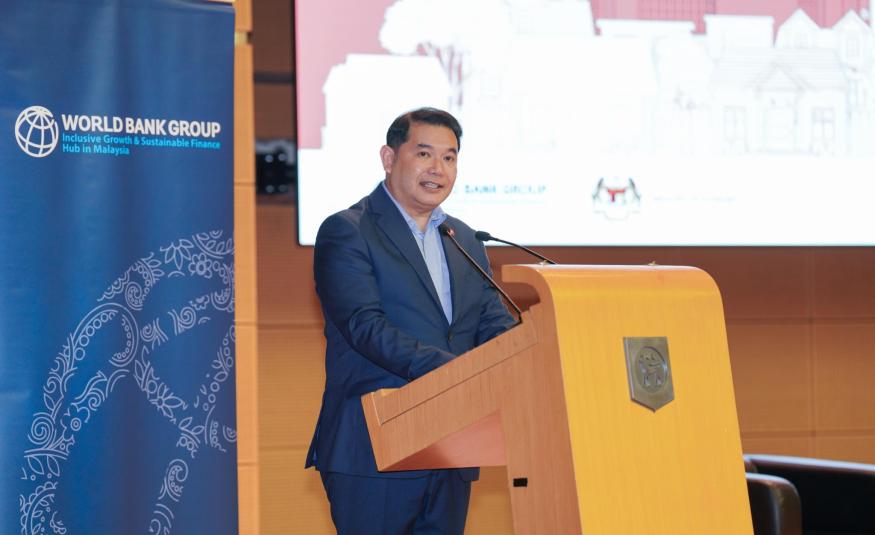
As Malaysia’s new Cabinet steps into its full stride, it does so under the weight of the Madani Economic Framework — a bold, seven-pronged agenda designed to re-anchor Malaysia’s economic and social trajectory over the next decade.
But ambition alone is not strategy.
While the blueprint is commendable in scope, its success hinges not just on measurable outcomes, but on institutional coherence, ministerial discipline, and a clear separation between policy execution and public persuasion.
Rafizi Ramli, as Minister of Economy, now finds himself at the intersection of these competing demands — simultaneously crafting the economic vision and shaping the narrative to sell it.
His role has evolved beyond technocratic stewardship; it now borders on full-spectrum messaging, and with that comes both strategic opportunity and institutional tension.
The Madani Economy outlines seven ambitious targets: becoming the 30th largest economy in the world, rising to 12th in global competitiveness, climbing to 25th in the Human Development Index (HDI), raising labour’s income share to 45%, achieving the 25th rank in the Corruption Perception Index, cutting the fiscal deficit to 3%, and boosting women’s labour force participation to 60%.
Each goal is laudable — and structurally daunting.
For instance, Malaysia’s per capita income ranks 68th globally. Shouldn’t this matter more than GDP rank?
Similarly, improvements in competitiveness and HDI demand more than regulatory tweaks; they require sustained investments in education, health, innovation, and governance. The target of 45% labour income share will need either a productivity revolution or structural wage mechanisms — including the contentious progressive wage policy Rafizi has been promoting.
Ministerial Overlap: Who Sets Wages?
This is where Rafizi’s expanding remit becomes controversial. Traditionally, labour matters — wages, employment equity, workforce participation — fall under the Ministry of Human Resources. Yet Rafizi has taken a visibly public lead on the progressive wage agenda, potentially encroaching on another minister’s jurisdiction.
Is this technocratic overreach or a strategic pivot? Possibly both. Rafizi’s dual role as economic planner and public explainer forces him to operate as both architect and ambassador. But when messaging overtakes coordination — and optics supersede institutional clarity — coherence suffers.
Calling this propaganda may be excessive, but there’s no denying the performative dimension of Malaysia’s economic discourse today. Ministers must not conflate visibility with impact. Good reform demands execution, not just engagement.
Institutional Backing: The Madani Monitoring Unit
The formation of the Madani Monitoring Unit under the Prime Minister’s Department is a welcome step. But real oversight demands teeth. Complex goals like fiscal consolidation, corruption reduction, or gender equity require multi-ministry cooperation, not ministerial solo acts.
The fiscal deficit goal (3% of GDP by 2030) is essential — yet current revenues barely cover operating costs. Development spending is funded through debt. Without honest tax reform — including a fresh look at consumption-based taxation — the fiscal space to realise Madani’s ambitions will remain dangerously narrow.
From Slogan to Substance: Rafizi’s Real Test
The Madani vision resonates with a nation eager for renewal. But, in Robert Burns’ words, “The best laid plans of mice and men oft go awry.” Execution — not eloquence — will determine whether this framework becomes Malaysia’s great reset, or merely another policy brand fading into inertia.
Rafizi’s ambition is not in question. But ambition must be paired with humility, coordination, and institutional respect. As the public face of economic reform, he must lead — without overreaching.
Malaysia doesn’t need a Minister of Economic Messaging. It needs a Minister of Economic Delivery. - DagangNews.com
Economist Samirul Ariff Othman is an international relations analyst. He completed his graduate studies at Macquarie University in Sydney, Australia. The views in this OpEd piece are entirely his own.
Layari kami terus di DagangNews.com

Orang ramai dipelawa menghantar artikel ke ruangan PARAFRASA di [email protected] mengikut ketetapan berikut:
1. Berbentuk analisis peribadi (Op-Ed) mengenai sesuatu isu atau topik, bukan plagiat
2. Topik yang mendapat perhatian segera dan utama ialah
a. berkaitan perniagaan, perdagangan, keusahawanan, pelaburan
b. Ekonomi MADANI
c. Pembangunan ekonomi negara dan negeri khusus
d. Sektor industri khusus seperti minyak sawit, getah, penerbangan, minyak dan gas
e. ESG
f. Hak pekerja, hak majikan, hak asasi manusia
3. Sains & Teknologi
a. Penemuan penyelidikan Sains & Teknologi serta teori dan konsep
b. Langkah mengkomersialkan produk berasaskan R&D
4. Kaedah penulisan
a) Sebaiknya seorang penulis sahaja pada penama.
b) Berbahasa Malaysia
c) Bahasa Inggeris diterima tetapi akan diterjemah ke Bahasa Malaysia
d) Editor akan memutuskan jika mahu mengekalkan Bahasa Inggeris
e) Tidak melebihi 1,000 patah perkataan dan tidak kurang daripada 600.
f) Jika disertakan gambar, juga amat digalakkan tetapi jangan guna Google (elak langgar hakcipta)
5. Hantar HANYA kepada DagangNews.com
a) Jika didapati artikel sama disiarkan di media lain kerana penulis menghantar merata-rata, nama penulis akan disenaraihitamkan.
b) Sila kemukakan Nama sebenar, Cadangan nama siaran dan emel untuk dihubungi (untuk rekod).