
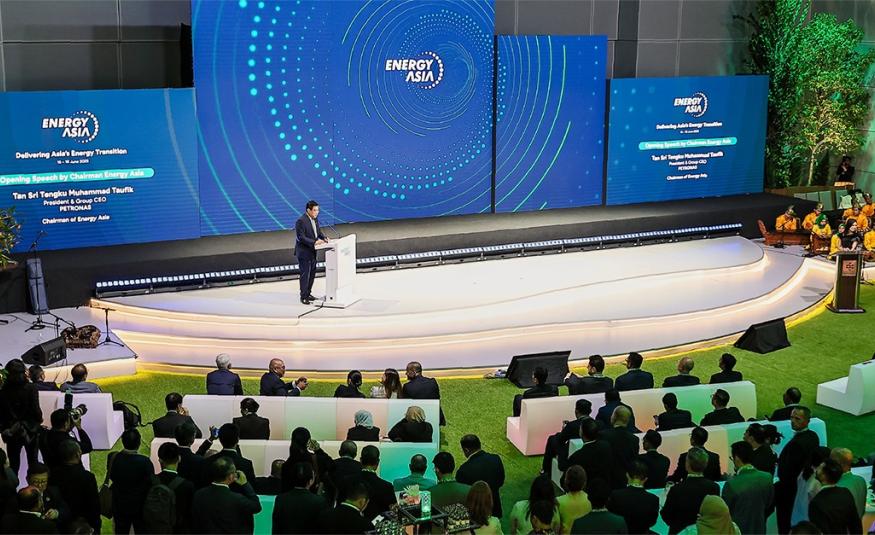
KUALA LUMPUR 17 June - As Energy Asia 2025 enters its final stretch, PETRONAS President & Group CEO Tan Sri Tengku Muhammad Taufik and S&P Global Vice Chairman Dr. Daniel Yergin delivered a direct message to Southeast Asian stakeholders: the region must close policy gaps, align investment frameworks, and rethink energy priorities—or risk falling behind in a new era of AI-driven demand and supply chain volatility.
Their remarks, delivered during a high-profile press conference on Day 2 of the summit, cut through optimistic narratives to underscore a difficult truth: the global energy transition is fragmenting, and Asia can no longer afford to operate in policy silos.
“This is not an either-or scenario,” said Tengku Taufik. “Asia must grow responsibly and equitably, but that means building systems that are regionally coherent, commercially viable, and environmentally sustainable.”
A Critical Moment for ASEAN Energy Strategy
Energy Asia 2025, organised by PETRONAS and held from June 16–18 at the Kuala Lumpur Convention Centre, convenes regional and global leaders under the theme “Charting Pathways for a Sustainable Asia.”
With over 4.8 billion people and one of the most diverse energy landscapes on the planet, Asia’s challenge is unique: growing demand, rising inequality, and uneven progress toward clean energy targets.
The summit’s closed-door EAGLE Forum brought together players from oil and gas, utilities, financial institutions, and multilateral bodies. The outcome, according to Tengku Taufik, was clear:
“If ASEAN is to lead, we need more than declarations. We need policy enforcement, investable frameworks, and shared regulatory confidence across borders.”
Malaysia’s Shifting Energy Position
Tengku Taufik acknowledged that Malaysia is on track to become a net energy importer within five years, citing rapid demand growth in Peninsular Malaysia, particularly from industrial and AI-related sectors.
To prepare, PETRONAS is developing a third regasification terminal and fast-tracking gas field development to ensure supply continuity.
“The 2 BCFD (Billion Cubic Feet per Day) currently supply will soon be outpaced,” he said. “While East Malaysia retains its export advantage, the peninsula’s growing energy appetite requires a strategic shift—including more LNG imports.”
AI Disruption and the Resource Bottleneck
Dr. Daniel Yergin, a globally respected energy expert, warned that the AI boom has created electricity needs the industry was unprepared for.

“Data centres are consuming enormous power, and that’s accelerating demand for natural gas,” he said. “We’re also seeing growing stress on copper supply—the essential metal for electrification.”
He added that while the energy system remains global, political fault lines and resource nationalism are fracturing trade flows, making diversification and regional coordination more critical than ever.
Carbon Pricing, CCS, and Reform
Asked about Malaysia’s proposed carbon tax by 2026, Tengku Taufik was cautiously supportive—provided it aligns with the government’s broader energy subsidy reforms and is implemented with market clarity.
“Subsidies distort pricing signals. A carbon tax, if transparent and targeted, can unlock clean technology investments,” he said. “We’re also looking at carbon capture and storage (CCS) as a commercially viable mitigation strategy.”
He noted that harmonised externality pricing across ASEAN could accelerate private sector participation and long-term infrastructure funding.
No Time for Complacency
Despite steady oil prices amid escalating Middle East tensions, both leaders warned against complacency. PETRONAS, which operates in Iraq and Abu Dhabi, is monitoring regional exposure closely.
“What looks like calm on the surface is anything but,” said Taufik. “This is a stress test for energy resilience.”
Yergin reinforced that message with a historical reminder:
“Churchill once said energy security lies in variety. That applies today more than ever.”
Actionable Outcomes from Energy Asia
Beyond speeches, Energy Asia 2025 has produced tangible commitments:
- A blue carbon initiative with academia and international partners
- Technology partnerships with firms such as Marubeni to accelerate clean energy deployment
- Ongoing work to ensure PETRONAS delivers low-cost, low-emission barrels to fuel a sustainable transition
“This summit isn’t about optics,” said Tengku Taufik. “It’s about building a layered, resilient energy ecosystem for Malaysia and the region.”
A Contest of Speed
For Malaysia and its neighbours, the transition is no longer a choice—it’s a contest of speed, credibility, and coordination. With AI redrawing the demand curve and regional vulnerabilities exposed, Energy Asia 2025 marks a turning point.
“We’re out of runway,” said Tengku Taufik. “To succeed, ASEAN must integrate—not just ideologically, but operationally.” - DagangNews.com
Layari kami terus di DagangNews.com

Orang ramai dipelawa menghantar artikel ke ruangan PARAFRASA di [email protected] mengikut ketetapan berikut:
1. Berbentuk analisis peribadi (Op-Ed) mengenai sesuatu isu atau topik, bukan plagiat
2. Topik yang mendapat perhatian segera dan utama ialah
a. berkaitan perniagaan, perdagangan, keusahawanan, pelaburan
b. Ekonomi MADANI
c. Pembangunan ekonomi negara dan negeri khusus
d. Sektor industri khusus seperti minyak sawit, getah, penerbangan, minyak dan gas
e. ESG
f. Hak pekerja, hak majikan, hak asasi manusia
3. Sains & Teknologi
a. Penemuan penyelidikan Sains & Teknologi serta teori dan konsep
b. Langkah mengkomersialkan produk berasaskan R&D
4. Kaedah penulisan
a) Sebaiknya seorang penulis sahaja pada penama.
b) Berbahasa Malaysia
c) Bahasa Inggeris diterima tetapi akan diterjemah ke Bahasa Malaysia
d) Editor akan memutuskan jika mahu mengekalkan Bahasa Inggeris
e) Tidak melebihi 1,000 patah perkataan dan tidak kurang daripada 600.
f) Jika disertakan gambar, juga amat digalakkan tetapi jangan guna Google (elak langgar hakcipta)
5. Hantar HANYA kepada DagangNews.com
a) Jika didapati artikel sama disiarkan di media lain kerana penulis menghantar merata-rata, nama penulis akan disenaraihitamkan.
b) Sila kemukakan Nama sebenar, Cadangan nama siaran dan emel untuk dihubungi (untuk rekod).