
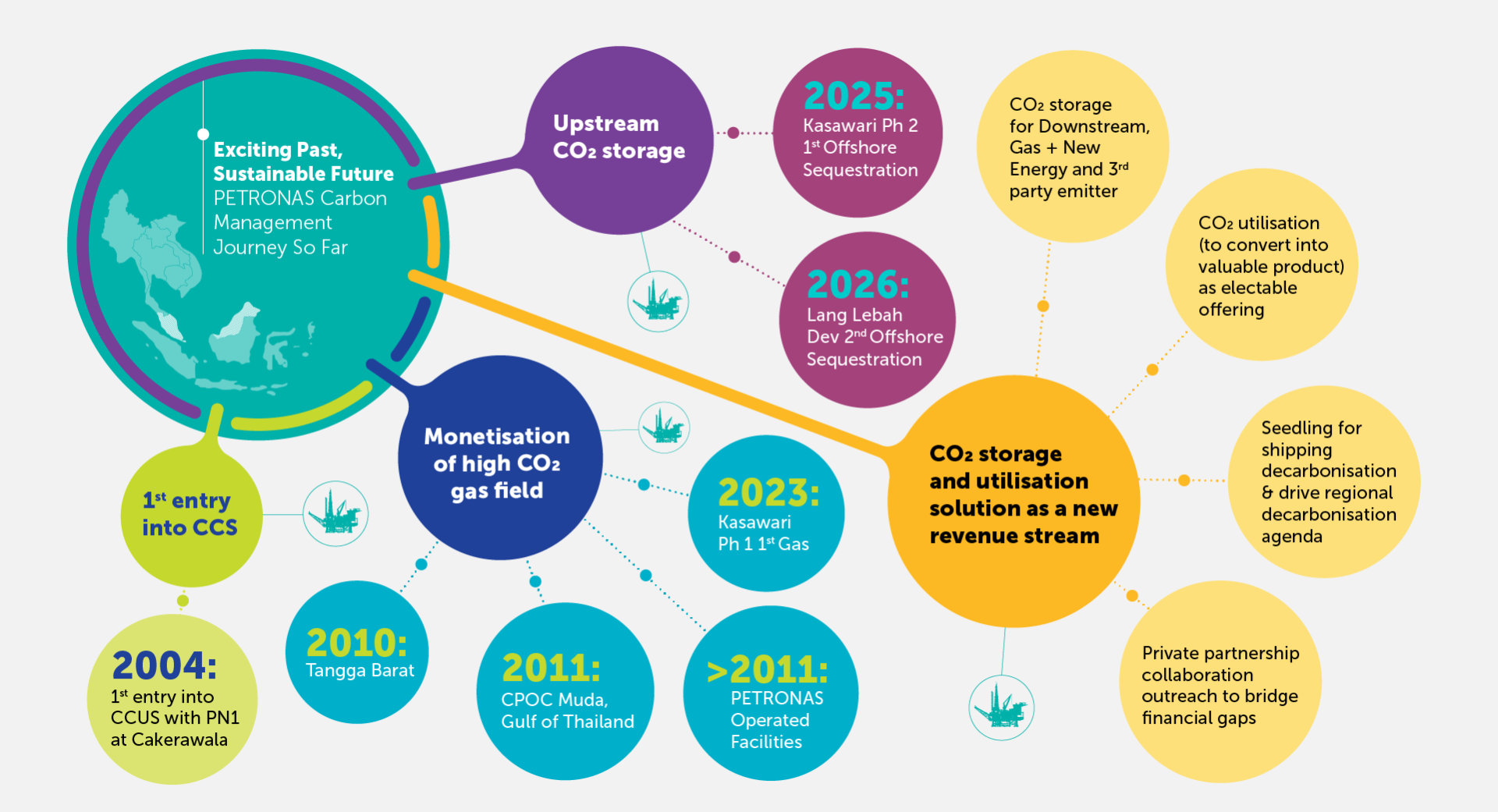
PETRONAS is fast-tracking Malaysia’s ambition to become a regional carbon storage hub through a bold, multi-project Carbon Capture and Storage (CCS) roadmap.
The plan, unveiled during an exclusive media dialogue on the sidelines of Energy Asia 2025, signals the company’s long-term commitment to decarbonisation and green industrial development.
“This isn’t just about emissions,” said Emry Hisham Yusoff, Senior General Manager of PETRONAS’ Carbon Management Division. “It’s about building the next engine of Malaysia’s industrial competitiveness.”
“A lot of people look at just the ‘storage’ part of CCS,” he said. “But once we have the infrastructure in place, Malaysia can become a destination for low-carbon industries like blue ammonia, blue hydrogen or even blue steel production.
“Instead of building new plants in places without CCS facilities, companies can leverage Malaysia’s capability to store captured CO2.”
“By attracting low-carbon industries to Malaysia, CCS can help build a new economic sector around decarbonisation. First, it supports our climate goals. Second, it contributes to the economy through infrastructure spending and services. And third, it creates spillover potential.”

Kasawari CCS: Flagship Project, High Stakes
PETRONAS’ leading CCS project, Kasawari, is expected to cost between RM4.5 and RM5 billion, and will store captured CO2 in the offshore M1 field.
“We’ve identified five to seven storage sites. This includes solutions for non-oil and gas industries like cement and steel,” Emry said. “The goal is to enable decarbonisation across the Malaysian economy.”
Other storage sites include Duyong (developed with TotalEnergies and Mitsui), Penyu (a saline aquifer project with ADNOC and UK-based Storegga), and Lawit. An onshore terminal is also underway at Kuantan Port, designed to serve the Malaysia-China Kuantan Industrial Park and nearby emitters.
Cross-Border Ambition and Infrastructure Build-Up
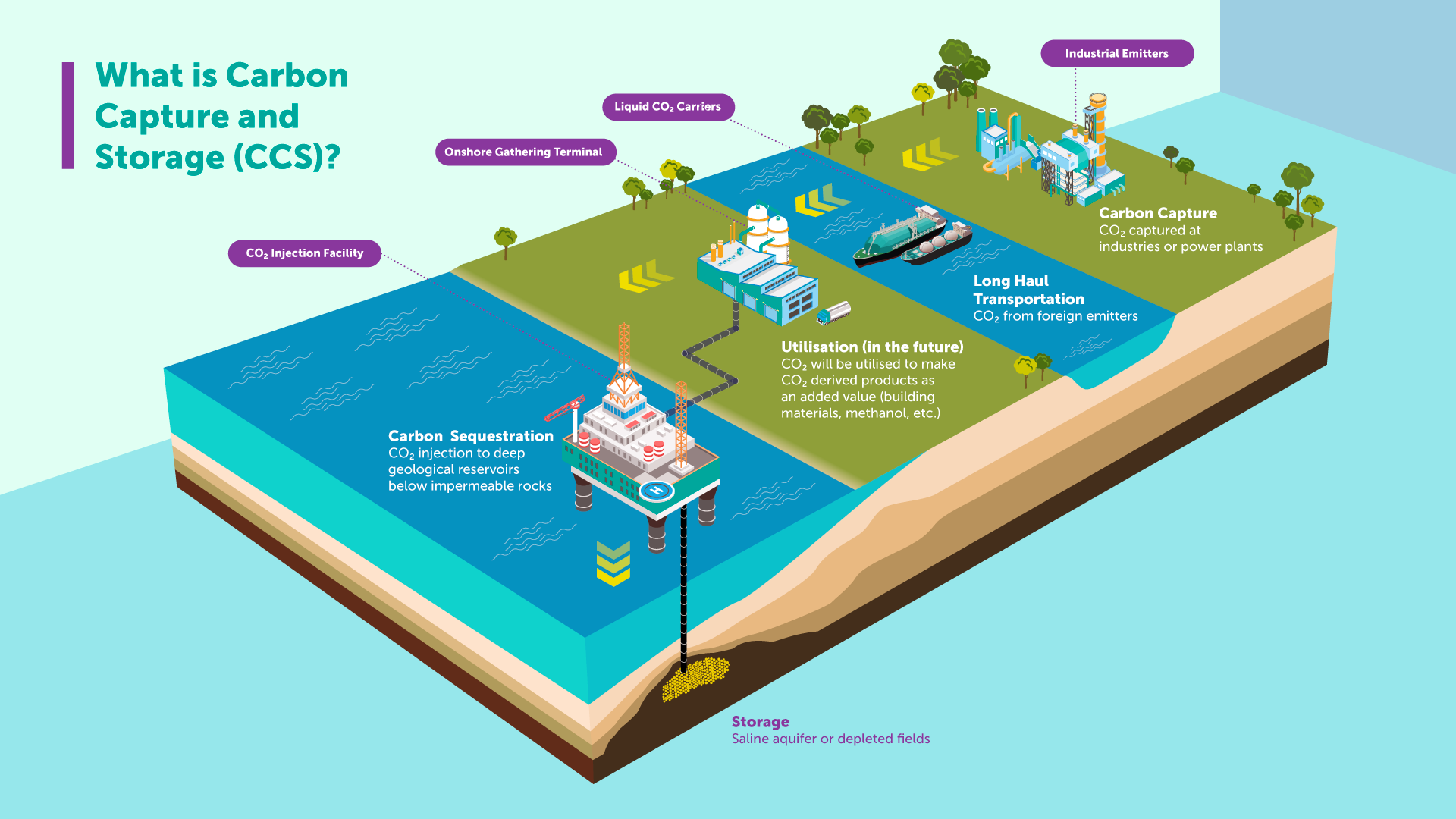
Malaysia’s CCS strategy goes beyond national emissions. With interest from Japan, South Korea, and Singapore, PETRONAS is also designing large-scale liquid CO2 vessels to support cross-border carbon shipping. Pipelines and terminals will link industrial emitters to offshore reservoirs.
“What we’re building isn’t just for Malaysia,” Emry explained. “With bilateral frameworks in place, we can offer long-term carbon storage to regional economies — and help them meet their climate targets.”
Technical Complexity and Strategic Partnerships
PETRONAS acknowledged the CCS value chain’s complexity — spanning capture, transport, storage, and financing.
“The CCS value chain is far more complex than storage alone,” Emry said. “You need to deal with capturing process, shipping, port handling, and financial frameworks — many of which still lack green financing classification.”
He said PETRONAS is now seeking local and international partners across the supply chain, having identified seven potential CCS sites in the country, in addition to three existing sites – two in Peninsular Malaysia and another in East Malaysia.
To manage these complexities, PETRONAS is working with global partners including Mitsui O.S.K. Lines, TotalEnergies, Storegga, and JGC Holdings.
“When it comes to CCS, we decided not to go alone,” he added. “There’s a lot of unknowns — and even after years of working on it, the complexity hasn’t disappeared.”
Legal Framework in Progress
Malaysia has recently passed a Carbon Capture, Utilisation and Storage (CCUS) Bill, which will establish a federal agency to license, monitor, and regulate carbon storage activities. PETRONAS has been closely involved in shaping the legislative groundwork.
“We’ve worked closely with regulators to push this forward,” Emry said. “It’s critical to gain public trust, foreign confidence, and long-term sustainability.”
The existence of the bill, pending gazettement, makes for a fairly robust regulatory framework for CCS for oil and gas operations, but still lacked clarity in several key areas — particularly for industrial emissions and cross-border carbon storage.
“Projects like Kasawari operate under clear guidelines. But when it comes to capturing CO₂ from industrial sources and storing it, there are still regulatory gaps.”
He added that cross-border carbon transport and storage introduces further complexity, particularly concerns over Malaysia becoming a “dumping ground” for carbon waste. Emry assures that in the case of CCS, this would not happen.
“This is different. We're dealing with greenhouse gases, and there is international accounting involved,” he said, pointing to bilateral agreements that ensure CO2 shipments from countries like Japan or Singapore are properly recorded and stored.
“We're pushing not just for legislation, but also for supporting regulations. For example, current environmental guidelines don’t require an Environmental Impact Assessment (EIA) for CO2 because it’s not classified as a scheduled gas, but we believe it should.”
Green Growth Outlook for Malaysia
By 2030, PETRONAS targets 80 million tonnes of annual CO₂ storage capacity and expects CCS to become a critical enabler of Malaysia’s low-carbon industrial future — from blue hydrogen to sustainable cement and fertilisers.
“Malaysia has the geology, infrastructure, and regional access,” Emry said. “With the right ecosystem, we can become the carbon storage hub for ASEAN.”
Key Highlights:
- Kasawari CCS investment: RM4.5–5 billion
- Target storage capacity: 80 million tonnes/year by 2030
- Major CCS hubs: Kasawari, Duyong, Penyu, Lawit
- Onshore terminal: Kuantan Port
- Cross-border clients: Japan, Korea, Singapore
- CCS Bill: Passed, awaiting full implementation
- First injection: Expected by late 2029 to early 2030
With escalating carbon border taxes and demand for low-carbon supply chains, Malaysia’s early CCS investments may offer not just climate dividends — but also a competitive advantage in global green trade and industrial reinvention. - DagangNews.com
Layari kami terus di DagangNews.com

Orang ramai dipelawa menghantar artikel ke ruangan PARAFRASA di [email protected] mengikut ketetapan berikut:
1. Berbentuk analisis peribadi (Op-Ed) mengenai sesuatu isu atau topik, bukan plagiat
2. Topik yang mendapat perhatian segera dan utama ialah
a. berkaitan perniagaan, perdagangan, keusahawanan, pelaburan
b. Ekonomi MADANI
c. Pembangunan ekonomi negara dan negeri khusus
d. Sektor industri khusus seperti minyak sawit, getah, penerbangan, minyak dan gas
e. ESG
f. Hak pekerja, hak majikan, hak asasi manusia
3. Sains & Teknologi
a. Penemuan penyelidikan Sains & Teknologi serta teori dan konsep
b. Langkah mengkomersialkan produk berasaskan R&D
4. Kaedah penulisan
a) Sebaiknya seorang penulis sahaja pada penama.
b) Berbahasa Malaysia
c) Bahasa Inggeris diterima tetapi akan diterjemah ke Bahasa Malaysia
d) Editor akan memutuskan jika mahu mengekalkan Bahasa Inggeris
e) Tidak melebihi 1,000 patah perkataan dan tidak kurang daripada 600.
f) Jika disertakan gambar, juga amat digalakkan tetapi jangan guna Google (elak langgar hakcipta)
5. Hantar HANYA kepada DagangNews.com
a) Jika didapati artikel sama disiarkan di media lain kerana penulis menghantar merata-rata, nama penulis akan disenaraihitamkan.
b) Sila kemukakan Nama sebenar, Cadangan nama siaran dan emel untuk dihubungi (untuk rekod).