

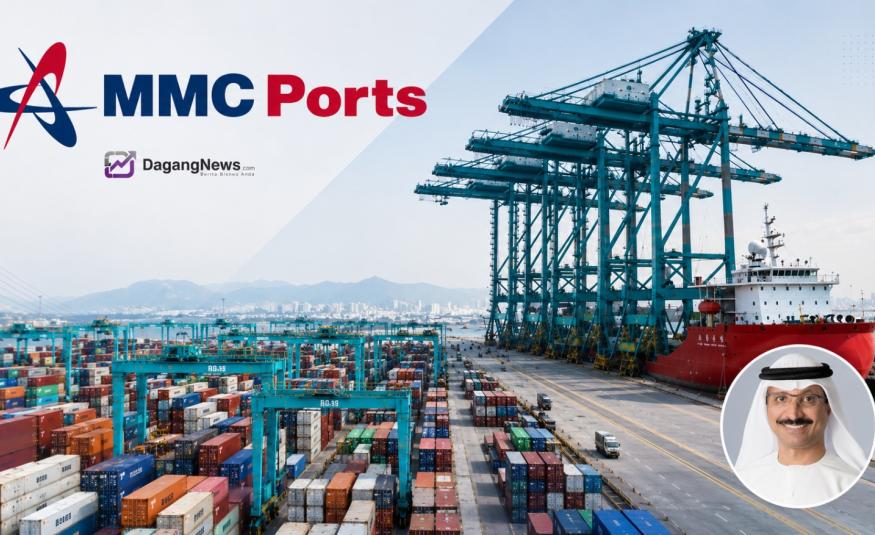
MMC Port Holdings Bhd (MMC Ports) today sits at the centre of one of Malaysia’s most important economic gateways.
As the country’s largest port operator, the group controls a network that handled more than 20 million twenty-foot equivalent units (TEUs) in 2025, connecting Malaysian industries and supply chains with some of the world’s busiest shipping routes.
Its importance, however, goes beyond the number of containers passing through its terminals.
Ports are where Malaysia’s position along the Strait of Malacca is converted into economic value. The more efficiently cargo moves through them, the greater Malaysia’s ability to attract shipping lines, trade flows, investment and the logistics activities that come with them.
For MMC Ports, that makes its network more than a collection of terminals. It is part of the infrastructure that determines how effectively Malaysia can compete for international trade moving through one of the world’s most important maritime corridors.
That role is becoming even more significant as the Strait of Malacca returns to global attention amid geopolitical tensions, disruptions to shipping routes and growing concerns over the resilience of international supply chains.
And it is against this backdrop that MMC Ports is entering perhaps one of the most interesting phases in its development — expanding capacity, accelerating digitalisation and bringing in one of the global port industry’s most recognised figures, Sultan Ahmed Bin Sulayem, as its Executive Chairman.
A trade route that shapes the national economy
The Strait of Malacca is more than a shipping lane connecting the Indian and Pacific oceans. For centuries, it has been one of the arteries of world trade and remains one of the busiest maritime routes today.
Geopolitical developments in recent years, including conflict in the Middle East and disruptions to trade routes in the Red Sea, have again reminded the world that maritime security has a direct impact on the global economy.
For Malaysia, the importance of the Strait of Malacca runs much deeper.
According to Apex Securities Research, about 48% of Malaysia’s total trade in 2025 was transported by sea. The research firm also estimated that as much as 36.8% of the country’s total trade could be affected in the event of a major disruption to shipping through the Strait of Malacca.
Under the worst-case scenario, Malaysia’s economic growth in 2027 could slow to between 2.5% and 3.1%, while inflation could rise above 3%.
Those figures show that port efficiency today is no longer merely a measure of a company’s operational performance. It also affects the country’s economic competitiveness, the smooth functioning of supply chains and international investors’ confidence in Malaysia.
The greater the volume of international trade passing through Malaysian ports, the larger the spillover benefits to the domestic economy. Such activity not only creates jobs in logistics, shipping, warehousing, land transportation, ship repair, technology and professional services, but also increases government revenue through taxes, duties and related economic activities.
In other words, port competitiveness benefits more than the operator itself. It also determines how effectively Malaysia can capitalise on its position along one of the world’s most important trade routes.
Building Malaysia’s largest port network
MMC Ports did not become Malaysia’s largest port operator overnight.
Its journey began in Johor in 2001 when MMC Corp Bhd acquired a controlling stake in the Port of Tanjung Pelepas (PTP), a port developed as an alternative transhipment hub to Singapore.
The acquisition marked the beginning of an expansion strategy that would eventually create the country’s largest port network.
MMC subsequently increased its stake in PTP before taking over Johor Port, expanding into Northport at Port Klang, gaining full control of Penang Port and later adding Tanjung Bruas Port in Malacca.
Today, MMC Ports operates a network comprising PTP, Northport, Johor Port, Penang Port, Tanjung Bruas Port, Andaman Port, Port Klang Cruise Terminal and Langkawi Cruise Terminal.
This approach has enabled the group to build a complementary network spanning container handling, conventional cargo, liquid bulk cargo, cruise operations and domestic ferry services.
The results became increasingly evident in 2025 when MMC Ports made history by handling more than 20 million twenty-foot equivalent units (TEUs) across its port network for the first time.
The achievement cemented its position as Malaysia’s largest port operator.
More than just container volumes
The 20 million TEU figure is more than a new record.
It reflects the maturity of a port network built progressively over more than two decades.
PTP became the first Malaysian port to surpass 13 million and subsequently 14 million TEUs within a single year, strengthening its position as one of Southeast Asia’s major transhipment hubs.
Northport recorded the highest container throughput in its history at 3.80 million TEUs, while Johor Port set a new record of 1.08 million TEUs. Tanjung Bruas Port also achieved its highest container throughput since beginning container operations in 2019.
Taken together, the performance shows that MMC Ports’ growth is no longer dependent on a single flagship port. Instead, the group’s strength is now supported by several ports, each playing a distinct role within Malaysia’s logistics network.
The expansion has also been backed by continued investment in infrastructure.
At PTP, Berth Zero is being developed to increase future capacity, supported by the addition of 11 quay cranes capable of serving ultra-large container vessels and 41 electric rubber-tyred gantry cranes.
Johor Port, meanwhile, has completed two new jetties to increase its liquid cargo handling capacity.
MMC Ports’ focus, however, is no longer confined to building physical assets.
Having established Malaysia’s largest port network, the next step is to improve operational efficiency and maximise the value of the assets already developed.
Digitalisation as the next growth driver
That shift can be seen in the new direction being pursued by MMC Ports.
At the end of 2025, the group entered into a strategic partnership with NIZE Technology Co. Ltd, the technology arm of Shanghai International Port Group (SIPG), to develop a five-year Digital Master Plan.
The objective is not merely to introduce new technology, but to standardise operating systems, automation, data management and workflows across all ports under MMC Ports.
Among the initiatives being developed are group-level digital dashboards, digital twin technology and artificial intelligence (AI) applications for container yard planning and equipment utilisation.
Such an approach is hardly unusual among the world’s largest port operators.
At many international maritime hubs, competitive advantage is no longer determined solely by the length of a berth or the number of cranes, but by the ability to use data to accelerate vessel turnaround, optimise terminal operations and improve the efficiency of the overall supply chain.
For MMC Ports, digitalisation is no longer an option. It has become a necessity if its port network is to remain competitive in a rapidly changing industry.
A leadership transition that caught the industry’s attention
As MMC Ports strengthens its position as Malaysia’s largest port operator, another significant development has attracted the attention of the regional maritime industry.
Former DP World Chairman and Chief Executive Officer Sultan Ahmed Bin Sulayem was appointed Executive Chairman of MMC Ports following the departure of Datuk Azman Shah Mohd Yusof as Group Chief Executive Officer.
The appointment surprised many industry observers.
Not simply because of the leadership change, but because Sultan Ahmed is one of the most influential figures in the global ports industry. Over more than four decades, he helped transform DP World from a Dubai port operator into one of the world’s largest ports and logistics companies, with operations spanning dozens of countries.
According to industry sources familiar with the development, news that Sultan Ahmed had chosen to join MMC Ports left several maritime industry players in Singapore “taken aback.”
For them, the decision by the man who built DP World into one of the world’s largest port operators to lead Malaysia’s biggest port operator adds a new dimension to the longstanding competition between the two countries for transhipment business in the Strait of Malacca.
Of course, no single individual can transform the position of a port overnight. Yet in an industry heavily dependent on relationships with global shipping lines, international experience, reputation and networks can provide a strategic advantage that is difficult to measure through financial figures alone.
Building Dubai, not just DP World
Sultan Ahmed’s experience extends far beyond port operations.
Around five decades ago, Dubai had yet to emerge as the world-class trade, logistics and financial hub it is today. The emirate’s transformation was driven by the development of Jebel Ali Port, free-trade zones and logistics networks that ultimately established Dubai as a major gateway for trade between Asia, Europe and Africa.
Sultan Ahmed was among the key figures in that journey through his role at DP World. Under his leadership, the company expanded through a series of acquisitions and international investments, building a ports and logistics network spanning dozens of countries.
His contribution was not confined to ports.
He also played an important role in Dubai’s property development through Nakheel, the developer behind iconic projects including Palm Jumeirah, The World Islands and several large-scale urban developments that came to symbolise modern Dubai’s transformation.
His experience in integrating port development, logistics, trade and real estate gives Sultan Ahmed a broader perspective on how a port city can evolve into a world-class economic hub.
For MMC Ports, that experience comes at a time when the company has already succeeded in building Malaysia’s largest port network.
The challenge ahead is no longer simply to add capacity or acquire more ports, but to leverage the existing network to strengthen Malaysia’s competitiveness in an increasingly competitive maritime industry.
New opportunities in the Strait of Malacca
Malaysia’s position along the Strait of Malacca has not changed since the days of the Malacca Sultanate.
What has changed is the way the world trades.
Today, global shipping companies select ports not merely on the basis of location, but also operational efficiency, cargo-handling speed, technology, logistics connectivity and the ability to manage increasingly complex supply chains.
Competition is also intensifying.
Apart from Singapore, which has long been the region’s leading transhipment hub, other Asian ports are investing billions of dollars to expand capacity, accelerate automation and attract more international shipping lines.
In such an environment, geography alone is no longer enough.
Malaysia must ensure that its ports continue to evolve alongside the industry if the country is to fully capitalise on its position along one of the world’s most important trade routes.
The more ships and international trade that pass through Malaysian ports, the greater the economic spillover for the country.
The benefits extend beyond port operators to logistics companies, warehouses, transport providers, ship-repair businesses, technology firms, insurers, financial institutions and thousands of small and medium enterprises that form part of the wider supply chain.
At the same time, increased trade activity contributes to tax and duty collections and creates employment opportunities, generating a multiplier effect across the economy.
Foundations are in place
For MMC Ports, the foundations for long-term growth are already in place.
The group has Malaysia’s largest port network, steadily rising container throughput and a digital transformation plan now being implemented.
Sultan Ahmed’s arrival adds a different dimension.
He joins MMC Ports not when the company is building a new port network, but as it enters a phase that demands higher productivity, greater digitalisation and stronger international competitiveness.
Whether his experience in building DP World and helping transform Dubai into one of the world’s most important trade and logistics hubs can be translated into similar success in Malaysia remains too early to determine.
His appointment, however, has already been enough to draw the attention of the regional maritime industry.
For a company that has succeeded in building Malaysia’s largest port network, such experience could prove to be one of its most valuable assets as competition for trade flows through the Strait of Malacca enters a new phase. - DagangNews.com
Layari kami terus di DagangNews.com

Orang ramai dipelawa menghantar artikel ke ruangan PARAFRASA di [email protected] mengikut ketetapan berikut:
1. Berbentuk analisis peribadi (Op-Ed) mengenai sesuatu isu atau topik, bukan plagiat
2. Topik yang mendapat perhatian segera dan utama ialah
a. berkaitan perniagaan, perdagangan, keusahawanan, pelaburan
b. Ekonomi MADANI
c. Pembangunan ekonomi negara dan negeri khusus
d. Sektor industri khusus seperti minyak sawit, getah, penerbangan, minyak dan gas
e. ESG
f. Hak pekerja, hak majikan, hak asasi manusia
3. Sains & Teknologi
a. Penemuan penyelidikan Sains & Teknologi serta teori dan konsep
b. Langkah mengkomersialkan produk berasaskan R&D
4. Kaedah penulisan
a) Sebaiknya seorang penulis sahaja pada penama.
b) Berbahasa Malaysia
c) Bahasa Inggeris diterima tetapi akan diterjemah ke Bahasa Malaysia
d) Editor akan memutuskan jika mahu mengekalkan Bahasa Inggeris
e) Tidak melebihi 1,000 patah perkataan dan tidak kurang daripada 600.
f) Jika disertakan gambar, juga amat digalakkan tetapi jangan guna Google (elak langgar hakcipta)
5. Hantar HANYA kepada DagangNews.com
a) Jika didapati artikel sama disiarkan di media lain kerana penulis menghantar merata-rata, nama penulis akan disenaraihitamkan.
b) Sila kemukakan Nama sebenar, Cadangan nama siaran dan emel untuk dihubungi (untuk rekod).