
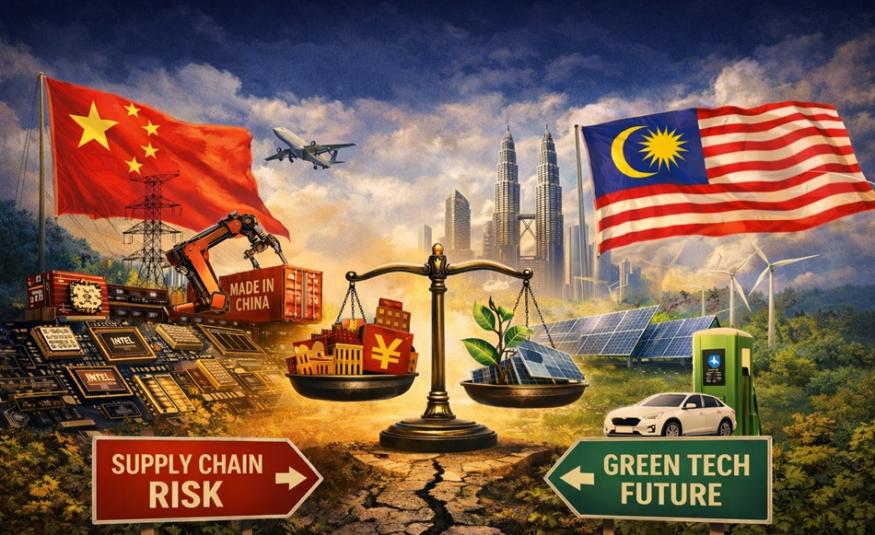
KUALA LUMPUR 31 Dec - Malaysia enters 2026 with a clear competitive edge over its Southeast Asian peers, but risks undermining its position as a leading investment destination unless it confronts deep reliance on Chinese technology and intermediate goods in strategic sectors, particularly green technology.
In a year-end interview with DagangNews.com, Alicia García-Herrero, Chief Economist for Asia-Pacific at Natixis and Senior Research Fellow at Bruegel, said Malaysia currently outperforms Indonesia, Vietnam and Thailand across most global competitiveness benchmarks, but faces a structural vulnerability as global supply-chain derisking accelerates.
“Malaysia currently enjoys a clear competitive edge over Indonesia, Vietnam, and Thailand across most international benchmarks,” García-Herrero said, citing improvements in infrastructure, government efficiency and high-value manufacturing capabilities.
However, she warned that this advantage could erode if Malaysia fails to reduce dependence on Chinese inputs in emerging sectors.

“For Malaysia and ASEAN more broadly to compete effectively in green tech, deliberate policies to reduce intermediate imports from China and build domestic or diversified sourcing are essential. Without such steps, the region will remain a downstream processing hub rather than a true innovation leader,” she said.
Malaysia’s recent rise in the 2025 IMD World Competitiveness Ranking, where it climbed to 23rd globally, reflects stronger business conditions and a more skilled workforce. García-Herrero highlighted Malaysia’s semiconductor ecosystem as a major differentiator.
“Malaysia continues to dominate semiconductor back-end processes, hosting major facilities for global leaders such as Intel, Infineon and AMD, while attracting substantial data-centre and AI-related investment,” she said, noting that this places the country ahead of most ASEAN peers in advanced manufacturing.
Structural factors, including higher per-capita income, better English proficiency and a diversified export base, also support Malaysia’s standing. While Vietnam remains competitive in low-cost assembly and Indonesia benefits from resource scale, García-Herrero said Malaysia offers the most balanced value proposition in the region.
Despite these strengths, she identified green technology as Malaysia’s weakest strategic link. ASEAN’s solar, battery and electric-vehicle supply chains remain heavily dependent on Chinese technology, capital and intermediate inputs.
“Despite hosting some of the world’s largest solar-module assembly operations, Malaysia imports the majority of its polysilicon, wafers and cells from China, limiting its positioning as a genuine derisking alternative for Western buyers,” García-Herrero said.
“This undermines Malaysia’s ability to attract non-Chinese green-tech investment at scale and leaves it exposed to any future restrictions on Chinese components.”
She contrasted Malaysia’s position with India, which has made greater progress in localising parts of the green-technology supply chain and securing commitments from U.S. and European firms.
Trade exposure adds another layer of risk. García-Herrero said Malaysia’s electrical and electronics sector is particularly vulnerable to U.S. trade measures.
“Malaysia’s electrical and electronics sector is by far the most exposed to U.S. trade measures, accounting for over half of total exports to the United States and roughly 40% of the country’s overall export value,” she said.
Integrated circuits, semiconductor devices and consumer electronics dominate bilateral trade, making any sustained increase in tariffs especially damaging.
“The current 19% reciprocal tariff rate already imposes a material cost disadvantage compared with competitors,” she added, warning that optical and scientific equipment could face similar risks if tariffs broaden.
Globally, García-Herrero expects 2026 to be a year of modest deceleration rather than crisis.
“The global economic landscape entering 2026 appears moderately weaker than in 2025, with widespread but generally modest deceleration across major economies,” she said.
China’s growth is expected to slow to around 4.8% amid property-sector adjustments, while the United States is likely to experience only marginal deceleration.
Europe, however, faces more pronounced headwinds from inflation pressures, energy-transition costs and tighter fiscal policy. Malaysia, she said, is likely to see some moderation as export growth softens.
On U.S.–China relations, García-Herrero struck a pragmatic tone. “The Trump administration is likely to maintain a relatively accommodative stance toward China through at least the 2026 mid-term elections,” prioritising market stability and domestic economic confidence, she said.
Supply-chain diversification toward ASEAN is expected to continue despite a possible pause in new Chinese investments.
“Supply-chain diversification away from China toward ASEAN is expected to continue in 2026, driven primarily by Western companies’ ongoing derisking strategies,” García-Herrero said, with electronics, machinery and green-energy components leading the shift.
She also flagged risks from tighter U.S. dollar liquidity and increased use of the renminbi in trade settlement. While RMB settlement reduces dollar exposure, she warned that limited convertibility creates a “captive loop” that can deepen reliance on China and constrain monetary autonomy.
To preserve its lead, García-Herrero said Malaysia must act decisively. Priorities include deepening semiconductor and AI capabilities, genuinely derisking supply chains by reducing reliance on Chinese intermediates, investing in high-tech infrastructure, and using diplomacy to mitigate tariff risks.
“Malaysia has an enviable starting position,” she said. “But competitive advantage is not permanent. It must be renewed through strategic vision, decisive policy action and sustained execution.”
Without confronting what she described as the “China dependency trap,” García-Herrero warned Malaysia risks losing ground in the very sectors that will define future economic power. - DagangNews.com
Layari kami terus di DagangNews.com

Orang ramai dipelawa menghantar artikel ke ruangan PARAFRASA di [email protected] mengikut ketetapan berikut:
1. Berbentuk analisis peribadi (Op-Ed) mengenai sesuatu isu atau topik, bukan plagiat
2. Topik yang mendapat perhatian segera dan utama ialah
a. berkaitan perniagaan, perdagangan, keusahawanan, pelaburan
b. Ekonomi MADANI
c. Pembangunan ekonomi negara dan negeri khusus
d. Sektor industri khusus seperti minyak sawit, getah, penerbangan, minyak dan gas
e. ESG
f. Hak pekerja, hak majikan, hak asasi manusia
3. Sains & Teknologi
a. Penemuan penyelidikan Sains & Teknologi serta teori dan konsep
b. Langkah mengkomersialkan produk berasaskan R&D
4. Kaedah penulisan
a) Sebaiknya seorang penulis sahaja pada penama.
b) Berbahasa Malaysia
c) Bahasa Inggeris diterima tetapi akan diterjemah ke Bahasa Malaysia
d) Editor akan memutuskan jika mahu mengekalkan Bahasa Inggeris
e) Tidak melebihi 1,000 patah perkataan dan tidak kurang daripada 600.
f) Jika disertakan gambar, juga amat digalakkan tetapi jangan guna Google (elak langgar hakcipta)
5. Hantar HANYA kepada DagangNews.com
a) Jika didapati artikel sama disiarkan di media lain kerana penulis menghantar merata-rata, nama penulis akan disenaraihitamkan.
b) Sila kemukakan Nama sebenar, Cadangan nama siaran dan emel untuk dihubungi (untuk rekod).