

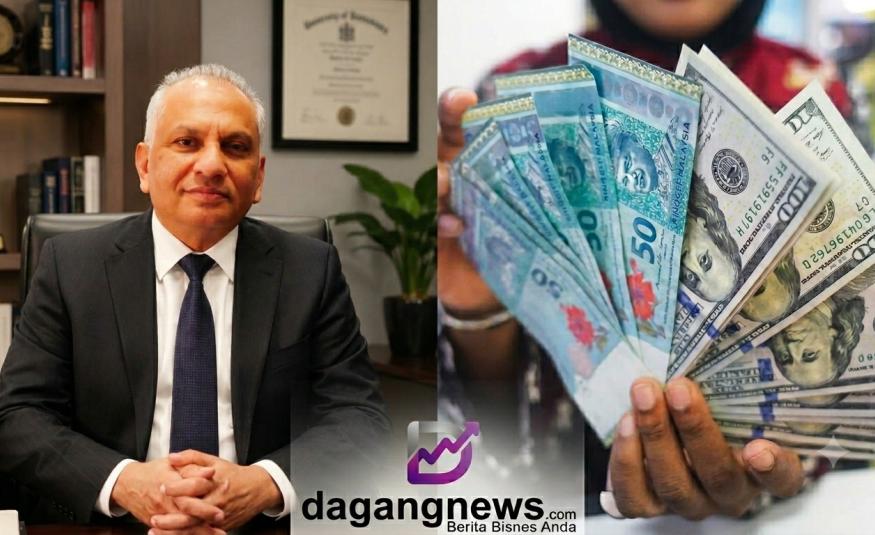
KUALA LUMPUR 23 June - Malaysian businesses and investors tracking the ringgit can take some comfort from the latest analysis by one of Asia’s most respected macroeconomic strategists.
Dr Sailesh Kumar Jha, Global Market Strategist and former Chief Asia Economist at Credit Suisse AG Singapore, says the ringgit is positioned to outperform several of its regional counterparts over the near term, even as geopolitical tensions in the Middle East continue to rattle global markets.
Speaking exclusively to DagangNews, Dr Jha placed the Malaysian ringgit (MYR) in the same outperforming bracket as the Chinese renminbi (CNH) and Singapore dollar (SGD), a notable endorsement at a time when several Asian currencies face depreciation pressures.
Ringgit among Asia’s top performers: Here’s why
Dr Jha’s currency call is grounded in his view that the US dollar index (DXY) has found a floor and will consolidate in the 97 to 101 range in the first half of 2026, before potentially strengthening further in the second half. In this environment, currencies with stronger fundamentals and policy credibility are expected to fare better, with the ringgit among them.
“CNH, MYR and SGD are likely to outperform in Asia,” he told DagangNews, drawing a clear distinction between these currencies and those facing pressure, including the Indonesian rupiah (IDR), Indian rupee (INR) and South Korean won (KRW).
For Malaysian exporters, importers and companies with US dollar-denominated exposures, this relative stability is significant. A ringgit that outperforms regional peers translates into more predictable hedging costs and reduced pressure on import bills, a timely signal as firms finalise 2026 financial planning.
BNM to hold rates: what it means for borrowers and the market
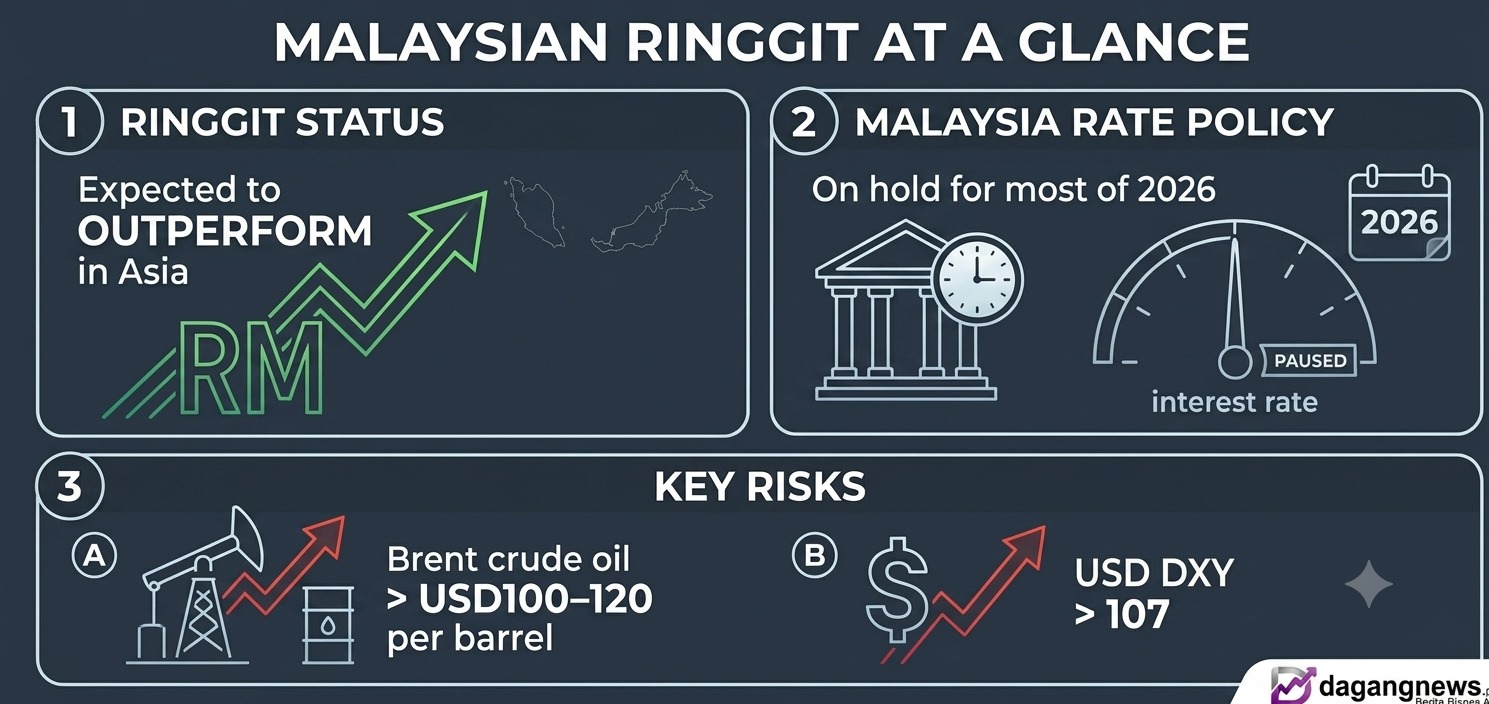
On domestic monetary policy, Dr Jha expects Bank Negara Malaysia to keep the Overnight Policy Rate (OPR) unchanged for most of 2026.
This contrasts with several regional peers, where China, Indonesia and Thailand are seen as candidates for rate cuts in the second half of the year, while Japan may move towards rate hikes.
Malaysia, meanwhile, is expected to remain in a steady holding pattern, reflecting what Dr Jha describes as a well-anchored macroeconomic position.
For the property sector, SMEs with floating-rate loans and businesses assessing capital expenditure timing, a stable OPR provides greater planning certainty compared to more volatile policy environments in the region.
The oil factor: Malaysia’s double-edged sword
As a net oil and gas exporter, Malaysia occupies a unique position when energy prices rise.
Higher Brent crude prices can support government revenue and the ringgit, but Dr Jha cautions that the current strength in oil prices is unlikely to be sustained.
He expects Brent crude to remain broadly within a USD77–87 per barrel range, based on his assessment that US-Iran tensions represent a short-term geopolitical flare-up rather than a prolonged crisis.
“My sense is that the current volatile events in the Middle East will not be a long-drawn-out affair,” he said. “Some form of stability should emerge in the next few weeks.”
Malaysian energy-related companies, including those linked to Petronas, are advised to monitor downside risks closely. A sustained spike above USD100–120 per barrel could shift the macroeconomic outlook, with implications for global demand, trade and capital flows.
Three red flags Malaysian businesses must watch
While the baseline outlook remains constructive, Dr Jha outlined three key scenarios that could trigger significant capital outflows from Asian markets, including Malaysia:
Brent crude sustaining above USD100–120 per barrel for an extended period, weighing on global growth and inflation simultaneously.
US equity markets entering a sustained bear market, triggering a global risk-off environment and pressure on emerging market assets.
The US dollar (DXY) breaking decisively above 107, while 10-year US Treasury yields remain around 5.0%, making US assets significantly more attractive than Asian markets.
“Under these extreme conditions, I expect significant net portfolio outflows from Asian capital markets and broad currency depreciation pressure across most Asian currencies,” Dr Jha warned.
For Malaysian fund managers, treasury teams and trade finance professionals, these thresholds serve as concrete monitoring indicators rather than abstract risks.
The bottom line for Malaysia
Dr Jha’s overall message to the Malaysian business community is one of cautious optimism. The ringgit is positioned on the stronger side of the regional currency divide.
Stable monetary policy from Bank Negara Malaysia provides a predictable financing environment, while Malaysia’s macroeconomic fundamentals continue to offer resilience amid global uncertainty.
Barring a major escalation in global risk, Malaysia’s financial markets are expected to remain relatively well insulated from Middle East-related volatility.
The key, he advises, is vigilance and agility — as shifts in global risk sentiment can quickly narrow the window for effective portfolio repositioning. - DagangNews.com
Dr Sailesh Kumar Jha is a Global Market Strategist and former Chief Asia Economist at Credit Suisse AG Singapore. With more than two decades of experience in investment banking and buy-side research, he has held senior roles across the United States, Singapore, Hong Kong, Malaysia, the Philippines and Taiwan.
Layari kami terus di DagangNews.com

Orang ramai dipelawa menghantar artikel ke ruangan PARAFRASA di [email protected] mengikut ketetapan berikut:
1. Berbentuk analisis peribadi (Op-Ed) mengenai sesuatu isu atau topik, bukan plagiat
2. Topik yang mendapat perhatian segera dan utama ialah
a. berkaitan perniagaan, perdagangan, keusahawanan, pelaburan
b. Ekonomi MADANI
c. Pembangunan ekonomi negara dan negeri khusus
d. Sektor industri khusus seperti minyak sawit, getah, penerbangan, minyak dan gas
e. ESG
f. Hak pekerja, hak majikan, hak asasi manusia
3. Sains & Teknologi
a. Penemuan penyelidikan Sains & Teknologi serta teori dan konsep
b. Langkah mengkomersialkan produk berasaskan R&D
4. Kaedah penulisan
a) Sebaiknya seorang penulis sahaja pada penama.
b) Berbahasa Malaysia
c) Bahasa Inggeris diterima tetapi akan diterjemah ke Bahasa Malaysia
d) Editor akan memutuskan jika mahu mengekalkan Bahasa Inggeris
e) Tidak melebihi 1,000 patah perkataan dan tidak kurang daripada 600.
f) Jika disertakan gambar, juga amat digalakkan tetapi jangan guna Google (elak langgar hakcipta)
5. Hantar HANYA kepada DagangNews.com
a) Jika didapati artikel sama disiarkan di media lain kerana penulis menghantar merata-rata, nama penulis akan disenaraihitamkan.
b) Sila kemukakan Nama sebenar, Cadangan nama siaran dan emel untuk dihubungi (untuk rekod).