
The Wawasanex consumer perception survey published last month puts precise numbers to what many have long observed about Malaysia's illicit cigarette trade.
According to the survey, 68.8% of respondents, equivalent to an estimated three million Malaysians, purchased illicit cigarettes in the past year. Seventy-three per cent of respondents identified migrant workers as the primary sellers, while 83.8% of buyers transacted at kedai runcit and Kedai Aceh, small retail outlets commonly operated by Acehnese migrants and widely associated with the sale of loose and illicit tobacco products.
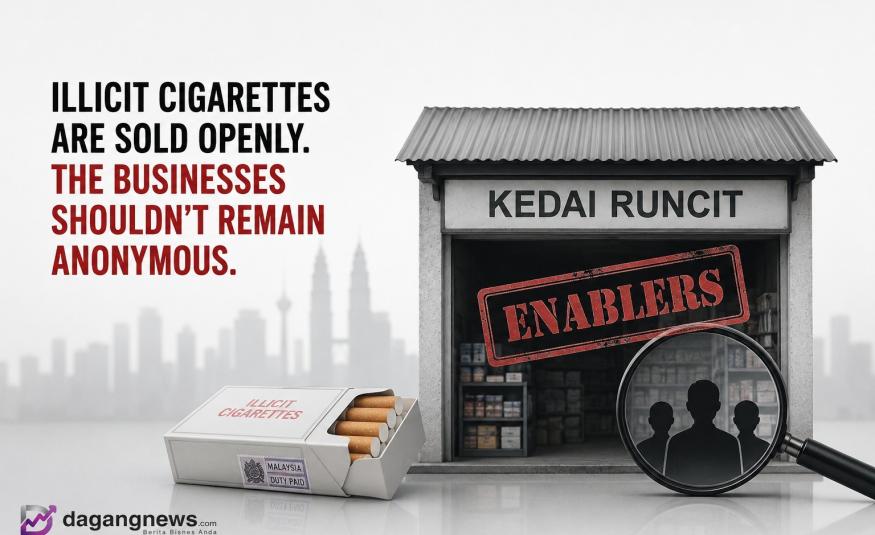
These products are sold openly, not at the margins of the formal economy.
The trade costs Malaysia an estimated RM5 billion annually in lost tax revenue. The problem is named, quantified and on the public record. The question that remains is not what the data shows. It is what the response must be.
Philippine authorities, acting on intelligence from the Royal Malaysian Customs Department, raided an illicit cigarette factory in April 2026 producing cigarettes with counterfeit Malaysian tax stamps worth RM80 million. Two Malaysia-based companies were identified as supply recipients.
Domestically, enforcement has intensified at the retail level. In Negeri Sembilan, the Royal Malaysian Customs Department inspected 38 outlets in the first quarter of 2026, seizing more than RM2.13 million worth of illegal cigarettes and initiating action against 26 individuals, with two foreigners charged in court.
Most recently, the General Operations Force detained a husband and wife in Kota Bharu on 7 June 2026 under Op Taring Wawasan Kelantan for storing and selling 19,600 sticks of smuggled cigarettes, with a Pakistani national linked to the operation.
The Accountability Gap
Yet a structural gap remains, and it is one that enforcement alone cannot close.
Every foreign national arrested at a retail premise for selling illicit cigarettes faces the full weight of the law: a minimum fine of RM100,000, the risk of deportation and a permanent ban from re-entering Malaysia. These are severe and appropriate consequences.
But they fall almost entirely on the most replaceable person in the operation.
The seller is removed. The premises remain open.
The survey found that 99% of respondents described illicit cigarettes as easy or very easy to obtain. This is not a trade at the fringes. It is a parallel retail economy, frictionless and open, with an enabling infrastructure that enforcement action can disrupt but not permanently remove.
Within a short period, a new seller is in place and the trade continues.
This is not a failure of enforcement effort. Datuk Dr Ameer Ali Mydin, one of Malaysia's most prominent retail figures, has said raids alone are not enough and called for enforcement to be continuous and sustained rather than seasonal.
The current accountability framework is calibrated to address the visible end of the supply chain while leaving its enabling infrastructure largely intact. A premise owner who knowingly permits the sale of illicit goods is a material participant in the trade.
A National Blacklist
The practical response is a national blacklist covering all parties found to be materially involved in the illicit trade, sellers and premise operators alike.
A publicly maintained registry of named individuals and business entities would serve several functions that enforcement action alone does not.
It would make consequences visible in a way that aggregate seizure figures cannot. It would impose a lasting commercial and reputational cost on premise operators, one that persists beyond any individual enforcement action.
Most importantly, it would give licensing authorities and business registration bodies a common reference that no single agency currently maintains in a coordinated form.
The deterrent logic is straightforward.
Under the present framework, a premise operator who permits illicit selling faces a risk almost entirely borne by the employee. If the seller is caught, the seller bears the consequence and the operator's business continues.
A national blacklist changes that calculation.
Inclusion on a public registry carries consequences for licensing renewals and future business registration that cannot be transferred to an employee or absorbed as a routine operating cost. The incentive to prevent illicit selling on one's premises becomes direct and consequential.
Public Support and Political Will
Eighty-seven per cent of Malaysians surveyed want stronger action against all parties involved in the trade. Forty-three per cent specifically support publicly naming businesses caught selling illicit products.
Prime Minister Anwar Ibrahim directed, at Cabinet level, that strict enforcement action be taken against any party found to have violated legal provisions or abused business licences and visas.
That directive establishes political will at the highest level.
What it now requires is a durable institutional mechanism to give it lasting form.
A national blacklist, covering sellers and premise operators without distinction, is that mechanism.
It would ensure that the consequences of involvement in this trade are not absorbed and forgotten at the conclusion of each enforcement cycle, but recorded, maintained and felt.
The political will exists. The public mandate exists. The mechanism does not.
That is the gap that must now be closed. - DagangNews.com
About the Author
FLK is a Malaysian capital markets practitioner and policy commentator with extensive experience in corporate finance, market structures and regulatory frameworks. With a strong interest in public policy design and regulatory effectiveness, FLK regularly contributes views on how legislation and regulation can balance investor protection, market efficiency and broader societal outcomes. His commentaries often focus on the importance of evidence-based policymaking, enforcement realism and long-term sustainability in regulatory decisions.
Layari kami terus di DagangNews.com

Orang ramai dipelawa menghantar artikel ke ruangan PARAFRASA di [email protected] mengikut ketetapan berikut:
1. Berbentuk analisis peribadi (Op-Ed) mengenai sesuatu isu atau topik, bukan plagiat
2. Topik yang mendapat perhatian segera dan utama ialah
a. berkaitan perniagaan, perdagangan, keusahawanan, pelaburan
b. Ekonomi MADANI
c. Pembangunan ekonomi negara dan negeri khusus
d. Sektor industri khusus seperti minyak sawit, getah, penerbangan, minyak dan gas
e. ESG
f. Hak pekerja, hak majikan, hak asasi manusia
3. Sains & Teknologi
a. Penemuan penyelidikan Sains & Teknologi serta teori dan konsep
b. Langkah mengkomersialkan produk berasaskan R&D
4. Kaedah penulisan
a) Sebaiknya seorang penulis sahaja pada penama.
b) Berbahasa Malaysia
c) Bahasa Inggeris diterima tetapi akan diterjemah ke Bahasa Malaysia
d) Editor akan memutuskan jika mahu mengekalkan Bahasa Inggeris
e) Tidak melebihi 1,000 patah perkataan dan tidak kurang daripada 600.
f) Jika disertakan gambar, juga amat digalakkan tetapi jangan guna Google (elak langgar hakcipta)
5. Hantar HANYA kepada DagangNews.com
a) Jika didapati artikel sama disiarkan di media lain kerana penulis menghantar merata-rata, nama penulis akan disenaraihitamkan.
b) Sila kemukakan Nama sebenar, Cadangan nama siaran dan emel untuk dihubungi (untuk rekod).